
Fitter or Tired?
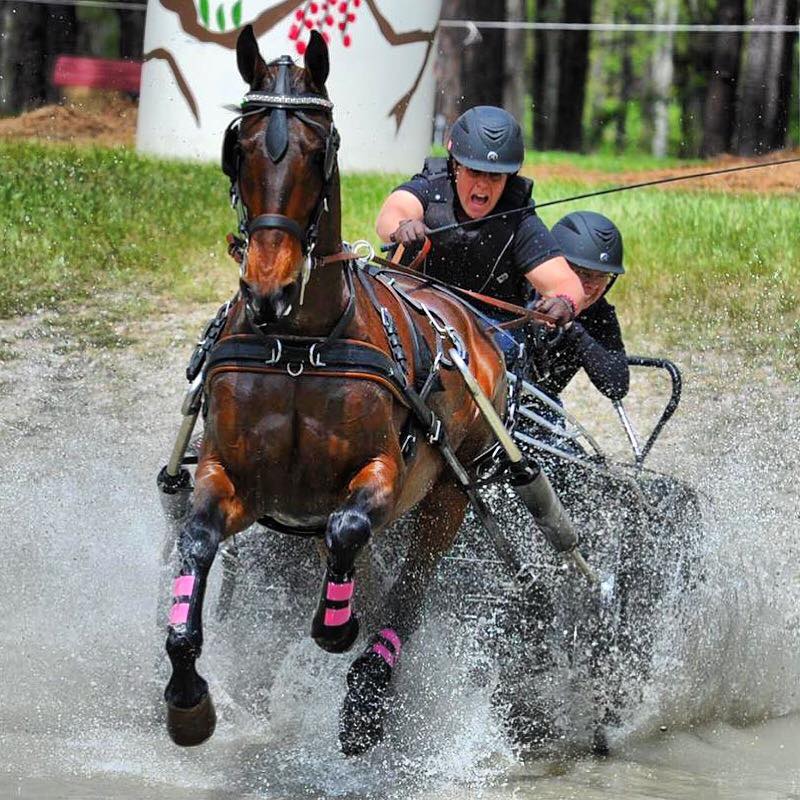
Is Your Horse Getting Fitter—or Just Getting Tired?

As trainers, we spend a lot of time deciding how much work a horse needs. We add distance, increase the pace, introduce hills, school more transitions or ask for another round through the cones. But there is an important difference between giving a horse more exercise and developing a horse that is truly fitter.
A horse finishing the same route faster does not necessarily prove that his fitness has improved. He may have pulled a lighter carriage, worked on better footing, traveled in cooler weather or simply been more enthusiastic that day. If we want to know whether a conditioning program is working, we need something more reliable than an impression.
Measure the same horse doing the same job
A 2026 review of exercise testing in sport horses emphasizes the value of standardized exercise tests. The principle is straightforward: repeat the same controlled workload under conditions that are as similar as possible, then compare how the horse responds.
As fitness improves, we may see a lower heart rate at the same workload, lower lactate production, faster recovery or the ability to perform more work before fatigue-related changes appear.
The important word is same.
Changing the route, speed, footing, distance, gradient or load makes the comparison much less meaningful.
For a carriage horse, a useful field test does not need to resemble a laboratory treadmill test. It could be a familiar route completed with the same carriage, similar load and planned periods of walk and trot. Record the temperature, humidity and footing along with the horse’s working heart rate and recovery after the drive.
For example, I might record the horse’s heart rate and respiration immediately after stopping, then again after two, five and ten minutes. Over several weeks, I am looking for a pattern—not one impressive number.
Is the horse completing the same job with less cardiovascular effort? Is he returning toward normal more quickly? Is his rhythm and way of going remaining consistent from the beginning of the session to the end?
With a pair, this becomes even more important.
Two horses can finish the same route at the same time while experiencing very different workloads. One may be doing more of the pulling, struggling more with balance or taking longer to recover. Whenever possible, each horse should be evaluated individually rather than assuming the pair’s performance tells the whole story.
Finishing the work is not the same as recovering from it
Recovery deserves as much attention as the work itself.
A 2025 study followed 40 race-trained Jeju horses after a short, high-intensity trial. Under passive recovery conditions, the researchers’ model estimated that blood lactate would take approximately 110 minutes to return below 2 mmol/L. The younger and unraced horses still had higher lactate concentrations 50 minutes after exercise than the older or more experienced horses.
This does not mean every carriage horse needs 110 minutes to recover after work. These were young race-trained horses completing an intense 800-meter trial, and breed, speed, conditioning, weather and workload all matter. It also was not a direct comparison of active versus passive recovery.
What it does show is that a horse can look outwardly settled before every part of his body has returned to baseline. Respiratory rate, heart rate, body temperature, hydration and metabolic recovery do not all normalize at precisely the same moment.
That matters especially with young horses, green horses and horses entering a new level of work. They may complete the task willingly and still need a more deliberate cooldown or a lighter following day. Experience and training produce physiological adaptations; enthusiasm alone does not.
What this looks like in a responsible program
Good conditioning is progressive and measurable. It develops the horse without repeatedly emptying the tank.
I want to see the horse finish with enough physical and mental reserve to maintain his rhythm, posture and responsiveness. After the harder portion of a session, I want purposeful low-intensity movement rather than an abrupt stop. After unhitching, I continue watching the horse instead of assuming recovery is complete because the carriage is put away.
Useful observations include:
* Heart rate and respiration at consistent intervals
* How quickly breathing becomes quiet and regular
* Heat and sweating relative to the conditions
* Willingness to drink
* Muscle tension and general comfort
* Appetite, manure and demeanor later that day
* Stiffness, fatigue or reluctance the following morning
None of these measurements should be interpreted in isolation. One unusual recovery reading may reflect heat, excitement, footing or equipment. A repeated pattern is far more valuable.
If a horse begins taking longer to recover from work that was previously comfortable, that is information—not something to train through automatically.
Training should create capacity, not simply fatigue
The goal of conditioning is not to prove that we can make a horse tired. It is to increase the amount of work he can perform comfortably while preserving soundness, confidence and willingness.
That requires us to know the difference between workload and adaptation.
Workload is what we ask the horse to do today. Adaptation is the change that allows him to do that work more efficiently in the future.
We only recognize the difference when we keep the work consistent enough to compare, track recovery and pay attention to the individual horse in front of us.
More work is not always better work.
The better question is: Is this horse becoming fitter, or are we simply becoming accustomed to seeing him tired?
Research referenced
Siegers, E.W. et al. “The use of exercise testing to assess training efficacy in sport horses.” Equine Veterinary Education (2026).
Sohn, Y. et al. “Quantitative modeling reveals prolonged lactate clearance in young and unraced Jeju horses following high-intensity exercise under passive recovery conditions.” American Journal of Veterinary Research (2025).


Comments