
Where to Look When Driving a Cones Course
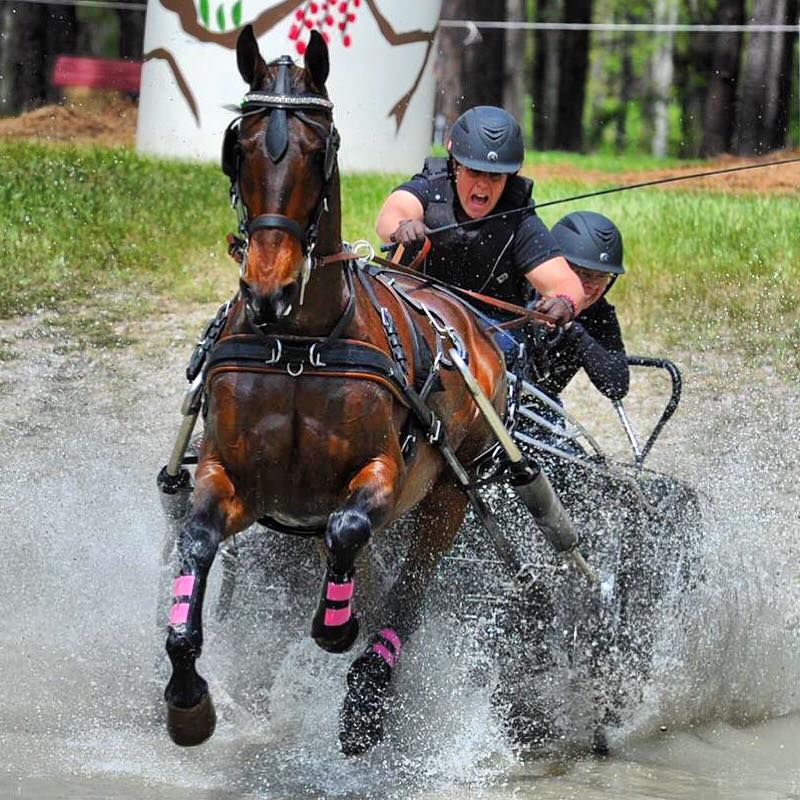


By Jess Buchanan Tanglao
If you look at the cone, you’ll hit the cone. Especially the one you’re staring at thinking, “Please don’t hit that one.”
I say this because it’s so easy to do. You come up to a tight gate, you’re pretty sure you’re a little close on the right, and suddenly that ball has your full attention. You want to see if the wheel will clear. But when you look down beside the carriage, you give up the view that would help you keep the turnout on line. And if your shoulder and hand follow your eyes, your horse may feel a change in the reins at exactly the moment you want them to keep going straight.
What my eyes are doing in these two photos
Photo 1 · Looking ahead. In the photo with the tan hat, I’m looking up to find my next obstacle. I can see where I want to go and start working out how much room I have to get there.
Photo 2 · Looking down. In the indoor arena photo, I’m looking down at the barrel beside me. You can see how much more my head is tipped. The barrel is close, and it’s easy to give it all my attention when I still have a line to drive out of the turn.
The same habit comes into play through cones. See the obstacle early enough to set your line, then look along the path you want the carriage to take.
A small change in your head can show up in your hands
Try this sitting in a chair. Hold your hands out the way you would hold your reins. Look straight ahead, then look down toward where your right wheel would be. Did your right shoulder drop? Did one hand move closer to your body? Try it on the other side. The two sides may feel different.
An adult head typically weighs around 10 to 12 pounds. When you tip that weight forward and to one side, it’s easy for the rest of you to follow. If a shoulder turns and a hand comes back, you can take up a little more contact on that rein without ever intending to ask for a turn. From the horse’s end of the reins, there’s no way to tell whether you meant to give an aid or were just checking on a cone.
Looking up makes it easier to stay balanced on the box seat and let your hands follow the horse. Keep your chin comfortable, your elbows soft, and your eyes far enough ahead to see where you’re going. You can look toward the next part of your line without taking your whole upper body with you.
Drive the line all the way through the gate
On the approach, I want to see both cones and pick out the middle of the gate. Then I want a point beyond it that gives me a line to drive. If I come out of a turn and aim straight at the opening before I’ve given the carriage room to follow, my horse may make it through while a wheel clips a cone. I need to think about the line the whole turnout is traveling.
The same thing happens on the way out. The horse’s nose clears the gate well before the wheels do. I can start looking ahead for the next obstacle while still holding the line I’m on. If I ask for the next turn too early, I can bring a wheel in toward the cone. If I wait to look up until I’ve watched the wheel go by, I may have already used up the room I needed to set up the next approach. My eyes can get there before my hands ask the horse to turn.
Try it at a walk
Set up one generous cones gate with enough room for a straight approach and exit.
As you approach, see both cones and choose a point beyond the middle of the opening. A fence post or a mark on the far wall works well if it lines up with the center of the gate.
Walk toward that point. Let the cones pass at the edges of your vision and keep walking straight until the wheels are through.
Make a few passes from each direction. If the same ball keeps coming down, have someone film from off to the side of your line. Watch your approach first, then look at where your head, shoulders, and hands go in the last few strides. Notice whether the carriage was already coming in at an angle or whether something changed as you reached the gate.
Once you can do that easily, add a second gate with a turn between them. Give yourself enough room to finish the first line. Find the second gate with your eyes, then notice where you need to start the turn to give your horse and carriage a good approach. Stay at the walk long enough to feel the difference between spotting the next gate and asking for it.
If you take one question into your next cones practice, make it this one. Where do I want the carriage to be three strides from now? Give your eyes somewhere to go, and give your horse a line they can follow.
If you enjoy learning the little things that make a big difference on the box seat, I’d love to have you as a Facebook subscriber. Your support helps me keep making driving videos, writing posts like this one, and sharing exercises you can take out to the barn and try with your own horse. Subscribe on Facebook
Reference for the head-weight estimate — University of Oregon Safety and Risk Services


Comments